ACT Practice Questions for Effective Reading Preparation
· based on the channel PrepSolution
Key takeaways
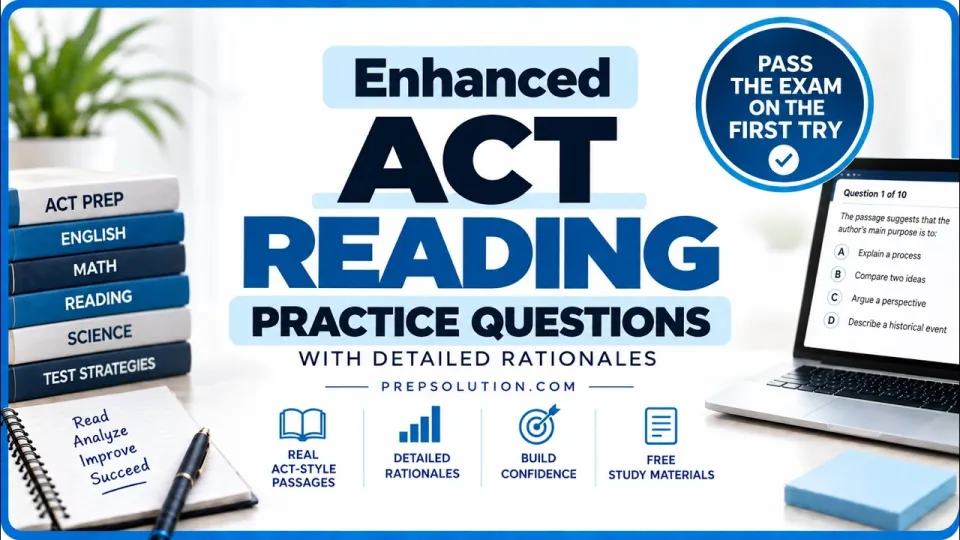
- Includes 10 detailed ACT Reading practice questions with two passages
- Focuses on main idea, details, inference, vocabulary, and point of view
- Teaches strategies to rule out wrong answers and find exact text evidence
- Offers tips to identify tempting distractors and improve reading comprehension
- Provides a scoring guide and encourages mapping passages for better understanding
ACT Practice Questions are essential for improving your ACT Reading score by familiarizing yourself with question types, passage structures, and effective strategies. These practice questions cover key areas such as main idea, detail location, inference, vocabulary in context, and point of view, helping you develop a systematic approach to answering confidently and accurately. For additional resources and registration, you can visit PrepSolution's ACT Complete Prep System.
Understanding ACT Reading Practice Questions
ACT Reading practice questions typically come from passages that are either literary narratives or informational essays. Each passage is followed by several questions that test different comprehension skills. The questions focus on identifying the main idea and purpose of the passage, locating specific details and understanding their sequence, making supported inferences, interpreting words and phrases in context, and analyzing the narrator’s point of view. Practicing these question types helps you recognize exactly what the test is asking and how to find the best evidence in the text.
How to Approach Main Idea and Purpose Questions
Main idea questions ask what the entire passage is about or what the author’s primary purpose is. A common pitfall is confusing a detail with the central idea. To avoid this, read the passage carefully and summarize it in your own words before looking at answer choices. Identify the overall message or theme instead of focusing on isolated facts. This skill is crucial because understanding the passage’s purpose guides you in answering other questions more accurately.
Strategies for Details and Sequence Questions
Details and sequence questions require you to pinpoint specific lines or statements in the passage and understand the order of events or steps presented. When answering these, carefully locate the relevant section in the text and confirm the exact sequence. Don’t rely on memory or assumptions. One effective method is to annotate or mentally map the passage as you read, noting key details and their order. This active reading technique improves accuracy and speed.
Making Inferences and Matching Evidence
Inference questions ask you to draw conclusions that are supported by the passage, not to speculate beyond the text. To answer correctly, identify the specific evidence that backs up your inference. Avoid answers that introduce new information or go beyond what the passage implies. Matching the inference to exact textual evidence is a reliable way to eliminate wrong choices and strengthen your reasoning.
Decoding Words and Phrases in Context
When unfamiliar words appear, don’t guess blindly. Instead, cover the word and read the surrounding sentence to understand its meaning from context. Words in context questions test your ability to use contextual clues such as synonyms, antonyms, or explanatory phrases nearby. Developing this skill reduces the time spent on dictionaries or external resources and improves your overall reading fluency.
Identifying Point of View and Narrator’s Role
Point of view questions focus on who is telling the story and how their perspective shapes the passage. Pay attention to pronouns and narrative voice to determine if the narrator is a character, an observer, or an objective voice. Understanding the narrator’s role helps clarify tone, bias, and the reliability of the information presented.
Tips and Tricks to Rule Out Wrong Answers
Many ACT Reading questions include tempting distractors—answers that seem correct but misinterpret the passage or rely on incomplete evidence. To avoid these traps, always cross-check each answer choice against the passage. Use these 10 rules as a checklist:
- Verify if the answer matches the passage wording or intent.
- Eliminate choices that add unsupported information.
- Avoid answers that focus on minor details rather than main points.
- Reject statements that contradict the passage.
- Look for answers with exact textual evidence.
- Be cautious with extreme language or absolute terms.
- Confirm the logical order for sequence questions.
- Use context clues for vocabulary questions.
- Distinguish between inference and speculation.
- Pay attention to the narrator’s voice and point of view.
Practice and Scoring
Work through sets of 10 questions based on two passages—one literary narrative and one informational essay—to track your progress. Mapping passages and pausing before answering each question enhances comprehension. Keep a score out of 10 to monitor improvement and identify which question types or passages are more challenging for you.
Useful Links
Explore PrepSolution’s ACT Complete Prep System
Conclusion
Consistent practice with ACT Reading practice questions strengthens your ability to analyze passages, locate evidence, and apply effective strategies. The detailed explanations and tips from PrepSolution equip you to avoid common pitfalls and improve accuracy. Utilize their comprehensive prep system for deeper practice and score improvement. Remember to practice regularly, map passages, and review your mistakes to build confidence for test day.
Source: ACT Reading Practice Questions | Detailed Rationales with Tips & Tricks · Markdown version
Questions & answers
What types of passages are included in ACT Reading practice questions?
ACT Reading practice questions typically include literary narratives and informational essays, each testing different comprehension skills such as main idea, detail, inference, vocabulary, and point of view.
How can I improve at answering main idea questions on the ACT Reading section?
To improve, summarize the entire passage in your own words to identify its central purpose and avoid confusing one detail for the main idea. Focus on the overall theme rather than isolated facts.
What strategies help with vocabulary questions on the ACT Reading?
Cover the unfamiliar word and use context clues from the surrounding sentence or paragraph to infer its meaning. Look for synonyms, antonyms, or explanations nearby to guide your understanding.
How does mapping passages assist in ACT Reading practice?
Mapping passages by annotating or mentally noting key details and their sequence helps you organize information, locate evidence quickly, and answer questions more accurately and efficiently.